

What Is The Slowest Animal In The World Answer
As climates and circumstances change, species must either evolve or autumn victim to any number of threats to their being. Habitat loss, excessive hunting, and affliction are all potential hazards faced by many animals in the globe both by and present. In this commodity, nosotros will hash out the 10 rarest animals in the world that still be within the wild. All of the rarest animals are critically endangered and in firsthand demand of conservation, or they will be lost to the world permanently.
#10. Vaquita

The single rarest beast in the world is the vaquita (Phocoena sinus). This porpoise lives only in the extreme northwestern corner of the Gulf of California in Mexico. Since the population was recorded at 567 in 1997, information technology has since declined to its current state of xviii. It is probable that the vaquita will exist extinct within a decade.
Different other porpoises, mature females average i nativity every two years which is double the length of time in other species. While other potential threats have been suggested, the unregulated utilize of gill nets for commercial fishing has been the unmarried biggest killer of vaquitas. Two studies showed that boats from a single port were responsible for the deaths of betwixt 7-15% of the entire vaquita population in merely one twelvemonth.
All of these species are and so close to the brink of extinction that it may already be likewise late to save some of them. Severely fragmented populations with a declining number of mature adults brand preserving these creatures naturally in the wild a gigantic challenge. The majority of these animals take express or no population in captivity either. For all of these reasons, it's as important as always to acquire virtually the difficulties facing some of the rarest animals in the world, and what nosotros may be able to do about them.
#9. Javan Rhinoceros
Maximilian Pawlikowsky/Shutterstock.com
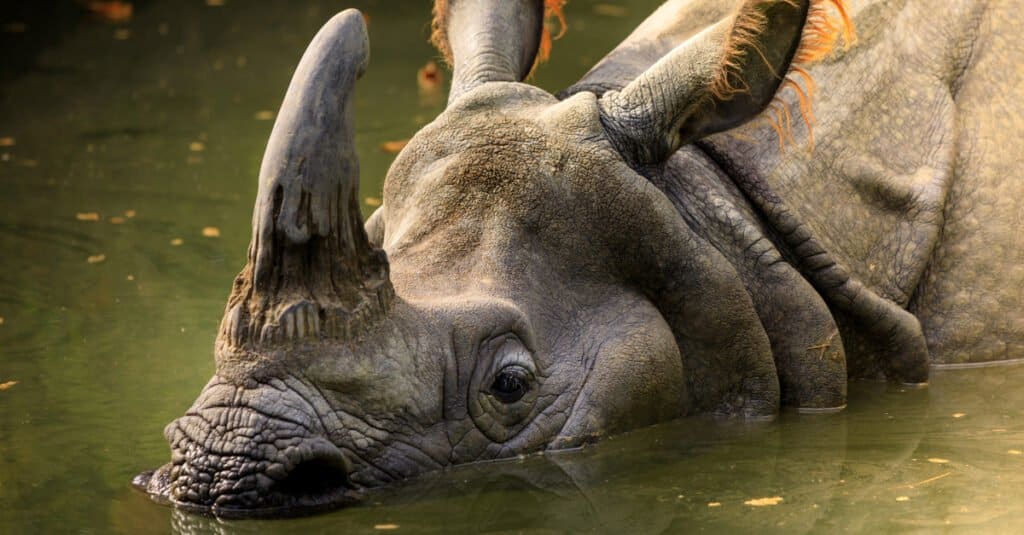
The Javan rhino (Rhino sondaicus) is an Indonesian rhinoceros that exists only inside 1 nature preserve on the island of Java. No other herds exist as the species is extinct in the entirety of its former region, and this preserve is occupied by the maximum amount of animals that it tin support at 68. The current mature adult population estimated to be capable of breeding stands at only 18.
The major threat to the Javan rhino is poaching to obtain its horn for resale and traditional Asian medicine. A unique threat facing this species is the presence of a palm called langkap. This palm is an invasive species that entirely choke out any other form of vegetation including the preferred diet for the rhinos.
#eight. Red Wolf
mruizseda/Shutterstock.com
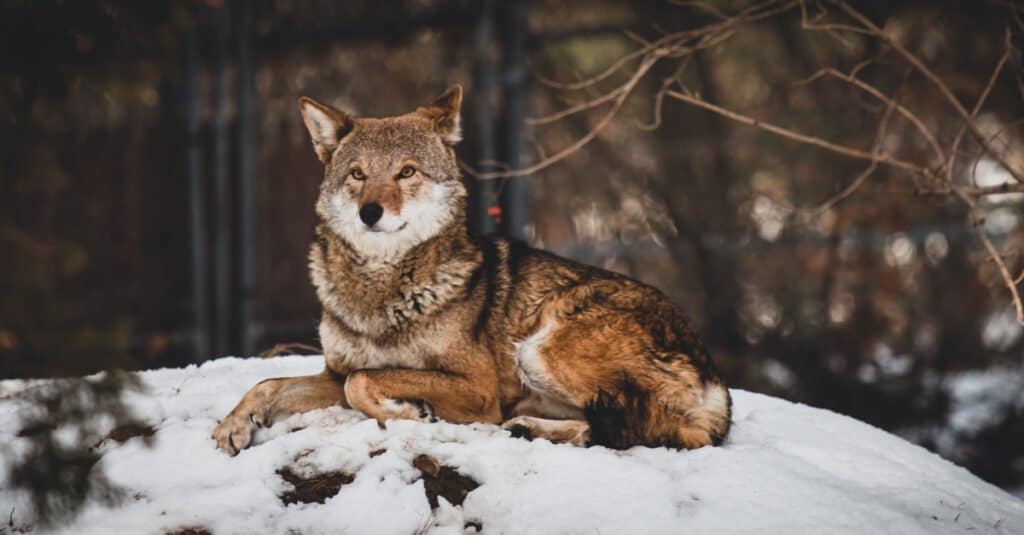
The red wolf (Canis rufus) is the only North American entry on our list of the rarest animals in the world, simply it is too one of the most threatened. This species was extinct in the wild past 1980, but it was reintroduced into Eastern North Carolina by the United states government in 1987. This reintroduction was so successful that over 150 animals established themselves in the region. This rapid growth brought about concerns over cross-breeding with coyotes and conflict with area landowners.
Every bit a result of those conflicts, the federal government reduced the program to only embrace federal lands and preserves in the easternmost part of the state. This region can only back up a pack of mature adults in the realm of 30 members. At this bespeak in time, the estimated population is believed to be below that number and declining.
#seven. Sumatran Rhinoceros
ylq/Shutterstock.com
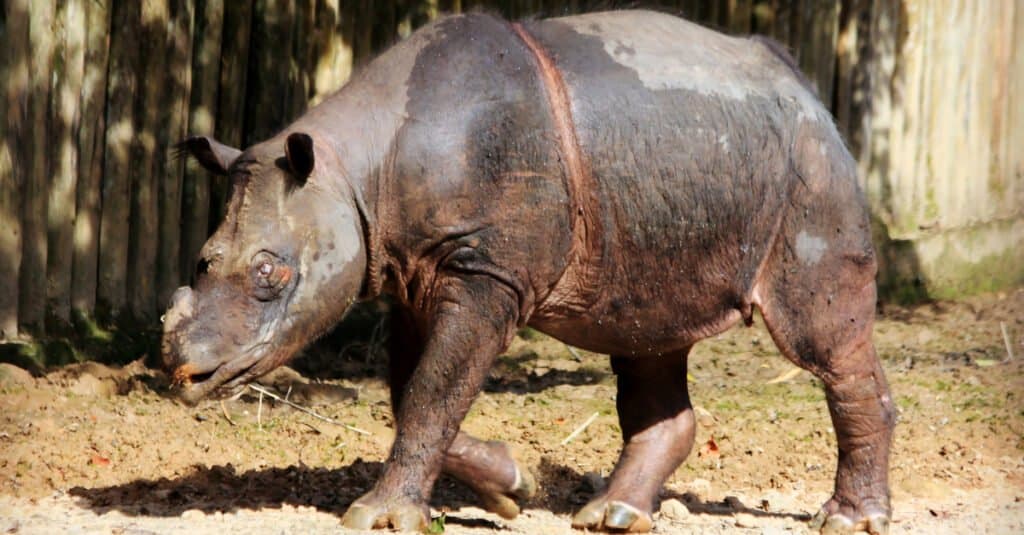
The Sumatran rhinoceros (Dicerorhinus sumatrensis) is the next entry on our listing of the rarest animals in the world, and this rhinoceros is i of the nearly critically endangered big mammals with populations but remaining in Indonesia. In the last 30 years, their population has been reduced by over 80% primarily due to poaching and habitat loss, and there are estimated to be only 30 mature adults left in feasible populations.
The population groups of the Sumatran rhino are so fragmented that it is impossible to join many of them together. Fifty-fifty with conservation efforts, it is unlikely that small populations of two to five rhinos can be saved, and the largest recorded group only has xv mature rhinoceroses.
#6. Gobi Acquit
The Gobi bear (Ursus arctos gobiensis) is a subspecies of brownish bears that exist only in the Gobi desert of Mongolia. There are less than 40 mature adults remaining in the wild, and no Gobi bears are held in captivity. This acquit is a rugged and persistent scavenger who manages to alive in a region that averages less than four inches of rainfall per twelvemonth.
Habitat loss due to mining in the area and uncontrolled grazing of other animals devastated the Mongolian grasslands of ages past, and this has resulted in a significant touch on all species living in the expanse. Furthermore, a xiv-twelvemonth drought in which less than two inches of rain fell annually farther depleted the deficient vegetation that the Gobi conduct lives on. Conservation efforts are in place such equally designating the bears' terminal three habitats one large national preserve, and researchers have tagged xx adults to monitor the population.
#5. Saola

The saola (Pseudoryx nghetinhensis) is a close relative of cattle just more closely resembles a deer. They are sometimes called the Asian unicorn due to their scarcity and their secretive behavior. The saola was only discovered in 1992 in the evergreen forests of Vietnam, and no report to estimate their population size has ever been successful due to the thick forests of Vietnam and the political climate of Lao people's democratic republic.
Threats to the saola include habitat loss and incessant hunting to fill the local demand for bushmeat and medicinal supplies. The saola is so infrequently captured on trap cameras that researchers take ended that it'south possible that no viable herds remain in beingness. There is no saola in captivity, and estimates in the wild range anywhere from 25-750 mature adults.
#4. Addax
Damian Lugowski/Shutterstock.com
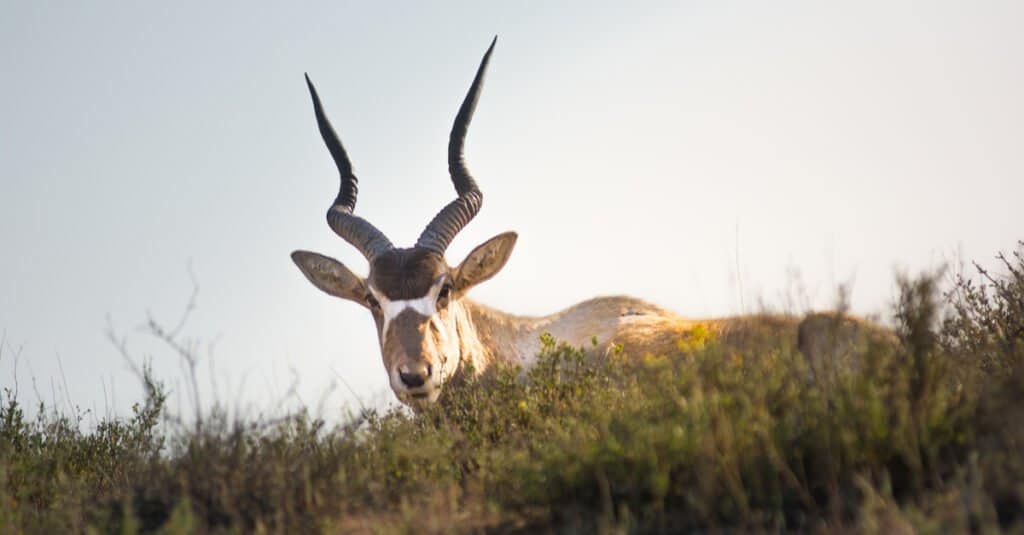
The addax (Addax nasomaculatus) is an antelope that previously ranged across the deserts of Africa. Today, y'all tin simply find them in the Termit Tin Toumma region of Niger. Thousands of addax live in captivity in various preserves around the globe, but but an estimated 30-90 mature adults still exist in the wild.
The addax were initially severely reduced past unregulated hunting, and the increase in oil drilling in their natural habitats and political instability has brought even more than armed humans to the region.
#three. Amur Leopard
Dmitri Gomon/Shutterstock.com
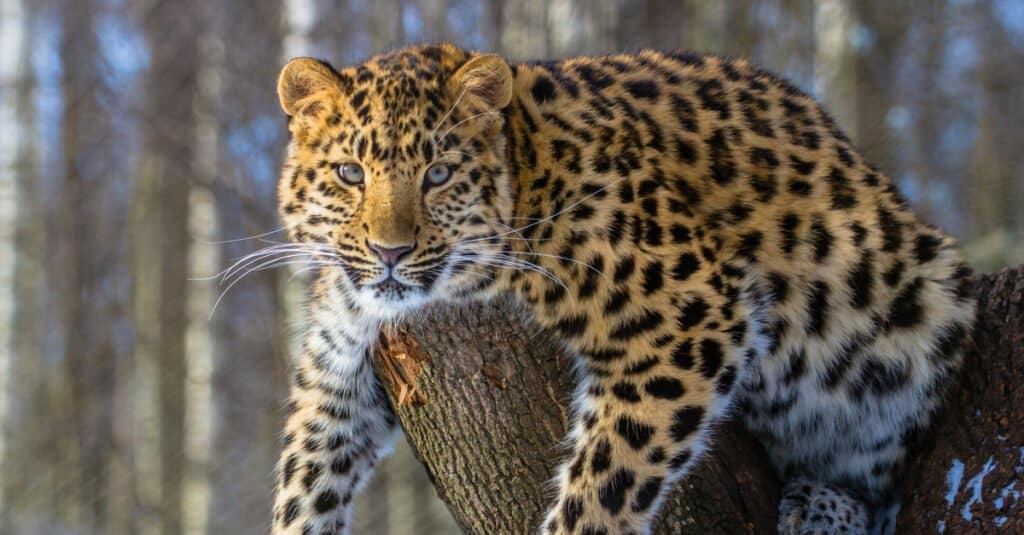
The Amur leopard (Panthera pardus orientalis) is a resident of the Amur region of Russian federation and Mainland china. It is almost exclusively hunted for its spotted fur, and its population has grown from an estimated fourteen adults in 2005 to around 84 mature adults today. The establishment of a preserve in the Russian Far Due east region has enabled the recent recovery of the species, but a lack of prey will inhibit a return to their old spread.
Weighing in betwixt 75-100 pounds, this impressive leopard can run at speeds of 37 mph, leap 19 feet horizontally, and spring 10 feet straight upwards into the air.
#ii. Philippine Crocodile
Peter Wey/Shutterstock.com
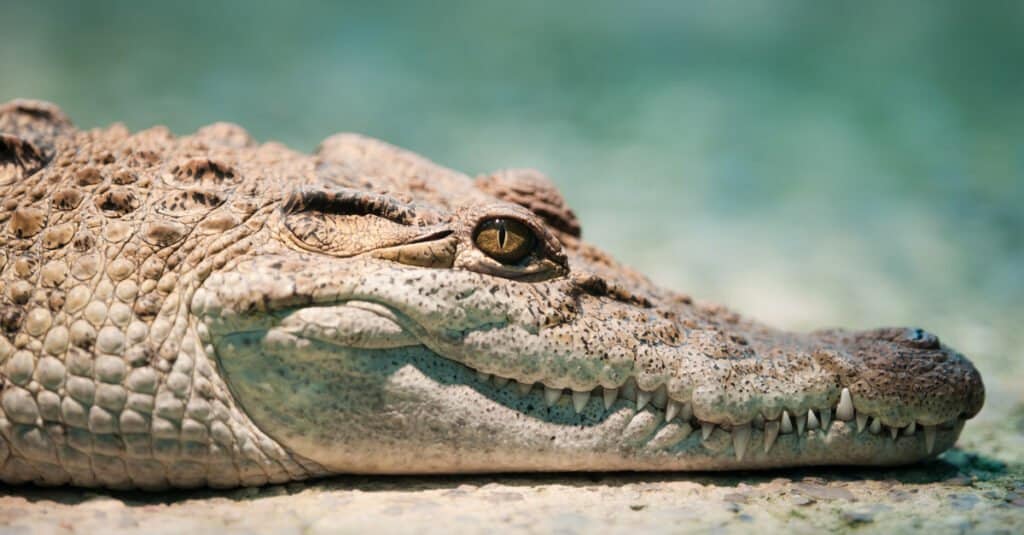
Philippine crocodiles (Crocodylus mindorensis) are not faring too every bit the kakapo. With an estimated declining mature adult population of 92-137 members, the species is severely fragmented across the inland wetlands of the Philippine Islands. This crocodile is smaller in stature than its relatives with the largest specimen captured in the wild existence nether 9 feet long. Their primary food sources equally adults consist of fish, pigs, dogs, and waterfowl.
#1. Kakapo
heather_p/Shutterstock.com
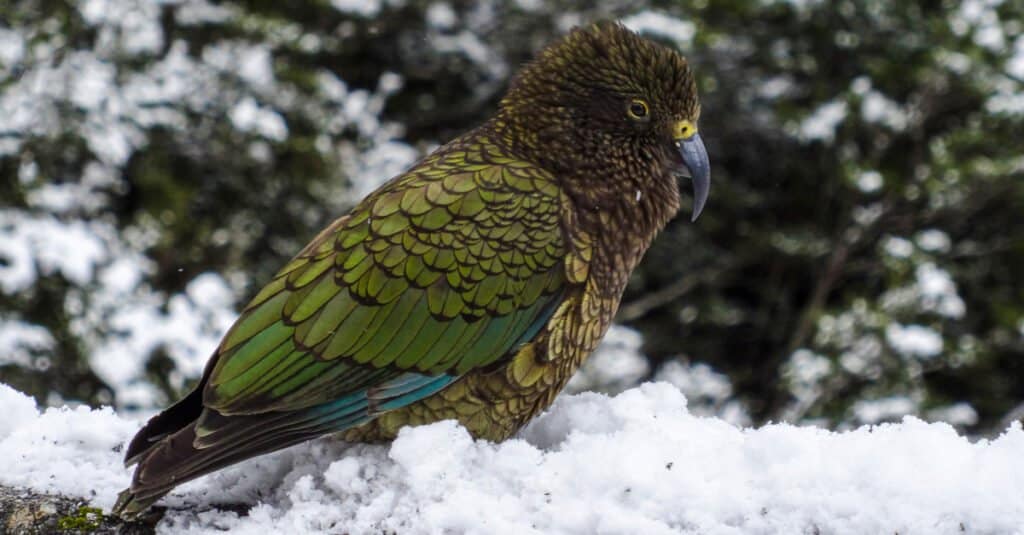
The kakapo (Strigops habroptila) is a nocturnal, flightless parrot with a lifespan of 60 years that is native to New Zealand. Kakapos were utterly devastated by the human colonization of the isle nation and the subsequent introduction of cats to the region. The parrot is believed to be extinct in its native range. A government-sponsored conservation and relocation effort has resulted in the species now steadily increasing in population size.
There are currently 116 mature adults spread across three smaller islands of New Zealand. The region is almost entirely protected, and all adults are tagged and monitored past conservationists. Testing of the breeding age adults and supplemental feeding have shown pregnant increases in the charge per unit of birth and overall survival.
Next up: ten Most Incredible Animal Migrations
Source: https://a-z-animals.com/blog/10-rarest-animals-in-the-world/
Posted by: emerickthavisa.blogspot.com
0 Response to "What Is The Slowest Animal In The World Answer"
Post a Comment