

Why Are Some Animals Better Adapted To Hear Particular Sound Frequencies Than Others?

How Human Noise Forces Animals to Modify Lifestyles
Hunting bats listen for different noises, and birds modify their song pitches
The following essay is reprinted with permission from The Conversation, an online publication covering the latest enquiry. 
Human being dissonance is forcing animals effectually the world to go through changes, unknown and invisible to most of us. It will be another example of the survival of the fittest: some species volition arrange and thrive; others will struggle to survive.
Our loud lives matter equally audio is crucial for many animals. Songs, grunts, roars or cheeps tin can be used to keep in contact with others, to warn of danger or defend territory, to attract a mate, or to beg for food from a parent. But cities interrupt these communications. Our route traffic or construction sites, even our talking, fill their ears with low-pitched noise. Then how exercise animals living in cities accommodate?
From eavesdropping to echolocation
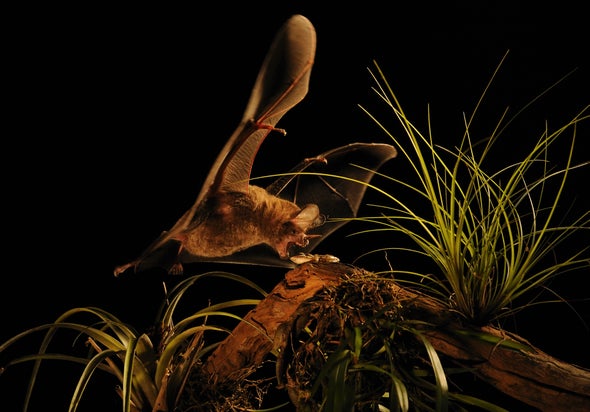
The fringe-lipped bat, of Primal and South America provides ane case. Using robotic, inflatable frogs and a large cage with microphones and speakers, a squad led by Wouter Halfwerk recently revealed how these bats take adapted their hunting to noisy conditions. Their report is published in the periodical Science.
Nearly bats use echolocation—a serial of ultrasonic chirps—to find their casualty. The fringe-lipped bat, nevertheless, along with a grouping including Europe's long-eared bat, normally hunts by listening for lower frequency sounds that humans could also hear. In this case, the researchers focused on the loud, croaking, mating calls produced by some species of frogs.
In the wild, the movement of the frog's song sacs as they inflate before they croak tin can exist picked upward by echolocation, so the bats could apply both listening (eavesdropping) and echolocation for hunting. In the cage they prepare upwardly for the experiment in Panama, scientists used pressurised air to inflate the robot's vocal sacs thus mimicking the wild frogs.
Halfwerk'south team wanted to detect out what happened if the mating calls were obscured past background noise, so they arranged the robot-frogs in such a way that some could only be detected by their husky while others could also be detected past bats using echolocation. Would the bats change their hunting strategy if they could not hear the husky above the loftier ambient audio played through the loudspeakers in the cage?
When the team flooded the muzzle with low-level, ambient, natural dissonance, both the non-inflating and the inflating robots were hunted in equal numbers. The bats heard the croaking and homed in on the robot frogs. However, when the volume of the ambient noise was turned upwards to obscure the sound made by the robot-frogs, the bats hunted only the robots which were having their song sacs inflated. In noisy conditions, the bats sent out twice as many echolocative calls as when it was quieter. The bats had switched to using echolocation to notice their casualty.
This change in behaviour is an example of what scientists phone call phenotypic plasticity—the ability of an organism to answer to changes in their surround with adaptations to their physique, behaviour or life wheel. These changes can occur very apace and may or may not exist permanent throughout their lifespan.
Of course, bats aren't the only animals to exhibit such plasticity of course, and other examples show how many species are adapting to alive alongside their noisy human neighbours.
Sing louder, and higher
Nightingales raise the book of their song in response to traffic noise and it also appears that they sing louder on weekday mornings than at weekends. Male person vocal sparrows shift their song into higher frequencies, and then it is not obscured by the lower rumble of cities. Similar observations take been fabricated in great tits and it was too found that the songs of urban bully tits were shorter and faster than those of their forest-abode cousins.
Such responses are not confined to birds: mammals, amphibians and insects have all responded in like fashion. Whales in noisy harbours and shipping lanes sing louder but less ofttimes. Californian ground squirrels shift their calls to higher harmonics where there are noisy wind turbines. In response to traffic noise, the southern brown tree frog from Commonwealth of australia and the bow-winged grasshopper in Deutschland shift their acoustic signals to a college pitch.
While singing louder and at a higher pitch are common responses, they are non the only adaptations that accept been seen and several urban birds have started singing at different times. For example, European robins now sing at night in areas that are noisy during the mean solar day.
But what does all this mean for wild animals in the cities of the Anthropocene? It is clear that some species are able to adapt to noisy environments. These are the species that showroom phenotypic plasticity, the generalists that can thrive in a wide range of ecology weather condition and make use of different resource. More specialised species, those that are not able to adapt, face condign locally extinct.
The generalists, the adaptors, are the species with the survival kits for the 21st century, the species many city-dwellers will see every day. Our noisy lives have unwittingly given these animals a helping paw.
This article was originally published on The Conversation. Read the original commodity.
Source: https://www.scientificamerican.com/article/how-human-noise-forces-animals-to-change-lifestyles/
Posted by: emerickthavisa.blogspot.com
0 Response to "Why Are Some Animals Better Adapted To Hear Particular Sound Frequencies Than Others?"
Post a Comment